Early 1900s
Before Development
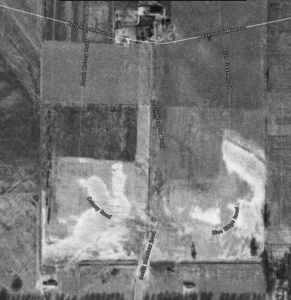 Before Hebron Meadows was developed, the land was part of a larger agricultural area on Evansville’s east side.
Historical records show the property was associated with the Buente family, who owned land in the area prior to subdivision. Like much of Vanderburgh County at the time, the landscape consisted of open farmland, field boundaries, and scattered farmsteads.
Early aerial imagery confirms that the area remained largely undeveloped into the late 1940s, with visible field patterns and minimal infrastructure.
1948
A New Subdivision Approved
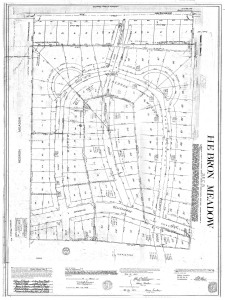 In 1948, Hebron Meadows was officially approved as a residential subdivision during a period of rapid post-war growth.
The development:
- Covered approximately 62 acres
- Was owned by Christ Buente and W. R. Harrell
- Was planned for mid- to upper-range homes
- Featured large lots and a structured layout
This marked the transition of the land from farmland to one of Evansville’s early suburban neighborhoods.
Early 1950s
Phased Building Begins
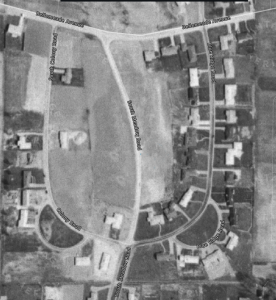 Hebron Meadows was not constructed all at once. Development occurred gradually throughout the early to mid-1950s. Thanks to it’s close proximity to St. Mary’s Hospital, many early homes in Hebron Meadows were built for the hospital’s doctors.
Aerial photographs from this period show:
- Initial construction along the outer streets
- Open land remaining through the center of the neighborhood
- Progressive infill as additional homes were built
Once a true open meadow, the central corridor, South Meadow Road, was the last street to be developed.
Mid1950s
A Growing East Side
As Hebron Meadows developed, Evansville’s east side was rapidly expanding.
The neighborhood became part of a broader shift away from the urban core, offering:
- Larger lots
- New construction homes
- A quieter residential setting
This period marked the beginning of the east side’s identity as a primary residential area for the city.
Mid to Late 1950s
A Community Takes Shape
By the mid-1950s, Hebron Meadows had grown into an established neighborhood with an active and engaged group of residents.
Newspaper records show residents participating in zoning hearings and organizing to oppose nearby commercial development, particularly along major corridors such as Green River Road and Bellemeade Avenue.
These efforts helped preserve the residential character of the neighborhood during a time of rapid change.
Late 1950s to Early 1960s
Infrastructure and Expansion
Throughout the late 1950s and into the 1960s, the surrounding east side of Evansville continued to develop rapidly.
Public infrastructure projects, including drainage improvements and storm sewer installations, were implemented to support this growth and improve conditions across the area. These upgrades helped transition Hebron Meadows from a newly established subdivision into a stable and fully developed neighborhood.
During this same period, the east side began to expand beyond residential development, with increasing pressure for commercial growth along nearby corridors.
Residents of Hebron Meadows were actively involved in local zoning discussions and frequently opposed nearby commercial proposals, including gas stations, restaurants, and the Lawndale Shopping Center. These responses were consistent with broader patterns seen in mid-century suburban neighborhoods, where residents often sought to limit commercial encroachment and maintain existing land use patterns.
Late 1900s
A Community Takes Shape
As Hebron Meadows progressed through the late 1900s, it became home to a number of established business owners, attorneys, physicians, and others active in the civic and economic life of Evansville.
The neighborhood also had strong ties to nearby institutions where many residents were involved in church life and community activities. Social connections, neighborhood gatherings, and shared institutions helped shape a close-knit and engaged community.
Today
A Lasting Identity
Today, Hebron Meadows remains a clear reflection of its origins. While many of the original residents have moved on, a small number of homes are still owned by their first occupants, with many others now in their second or third generation of ownership.
The neighborhood today includes a diverse mix of residents, backgrounds, and professions, with a blend of long-time homeowners and younger families continuing to shape the community.
Its distinctive tulip-shaped layout, architecture, and overall character continue to reflect the planning principles and design priorities of the post-war era. What began as farmland in the mid-20th century has become one of Evansville’s most intact and recognizable mid-century neighborhoods.